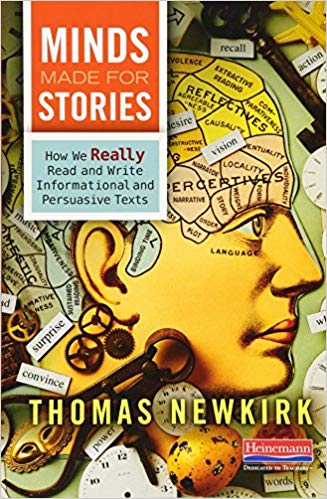
I loved the premise of this book (the subtitle is “How We Really Read and Write Informational and Persuasive Texts,” and it promises to reassert the priority – or maybe the primacy – of narrative as a means of understanding written text of any type), and the book itself doesn’t disappoint so far. I like Newkirk’s voice immensely – a kind of erudite, informal confidence that I aspire to.
The book starts immediately with two stories. The first is about Newkirk’s childhood and how his father helped him view science as a practical, hands-on, and messy, but also endlessly fascinating. The second is about his elderly mother’s loss of a sense of time. Both are connected to the purpose of the book, which I’d like to quote at length from the Introduction:
The book you are about to read has no appearance of a conventional narrative. But at its core, there is a conflict between the ways we treat narrative in school (as a type of writing, often an easy one) and the central role narrative plays in our consciousness. The hero of this story is narrative itself – how it comes to our aid as we sort out the welter of information that is available, as it undergirds our belief that our world is comprehensible, and meaningful, and one in which our actions have consequences. Narrative is there to help us “compose” ourselves when we meet difficulty or loss. It is there to ground abstract ideas, to help us see the pattern in a set of numerical data, to illuminate the human consequences of political action. It is home base (5).
This resonates powerfully with me, as I reflect more on the types of writing and writers I enjoy. Of course I enjoy fiction, and I love to read as much fiction as I can, and I constantly listen to audio fiction in the car, while running, and whenever else I can. I’m also working hard to read more nonfiction, and there are some nonfiction writers I struggle with, and some that I enjoy. Guess which ones I often enjoy? The writers who make their subject a story.
For me, this book helped crystallize some long-held beliefs about learning and thinking. It was the fuel for some decidedly unusual learning tasks I put on my students in 2017-18, and the major idea behind a presentation I gave at a conference that spring. I’m revising and reprising that presentation again this year, and I’m hoping to adjust to the successes and failures of the past. Most notably, it’s hard to sift through the stories to the science. It’s not a fair way to assess their scientific understanding, but instead functions better as a way to help them develop those understandings and diagnose – and treat – gaps. In other words, it’s an effective learning tool to ask them to create narratives about science. It’s an effective instructional tool if I share student-written narratives, or my own. But it’s not – and it probably should not be – an effective summative assessment tool. Of course, that doesn’t make it worthless. That makes it limited.
What do I mean by this? The classic example is having students adopt the identity of an organism in an ecosystem and explain a typical day in the life of that organism. I provide examples, give them a specific ecosystem (the forest preserve near our school), and give them a list of organisms to choose from. Then off they go. My middle school students appreciate the opportunity to decide if their story ends with the death of their organism or its escape to live another day. About half seem to enjoy writing something to the effect of “Then he ate me.”
The goal is understanding. I think that stories are key to that. I’d like to say more, but we’ve reached our limit here . . .


Leave a Reply